
Blog
Mindfulness & Meditation: 7 Techniques to reduce daily stress
Stress isn't a new problem, but when it builds up and lasts for a long time, it significantly affects your mood, sleep, focus, and overall quality of life. That's when mindfulness and meditation can help.
It doesn't mean mindfulness and meditation can completely remove stress. However, they can calm your mind and nervous system, making it easier to handle pressure and daily struggles. Regular practice can make stress more controllable and improve your life quality.
In this article, you will learn 7 mindfulness and meditation techniques that can help reduce daily stress and easily fit into your everyday routine.
Mindfulness vs. Meditation - What's the difference?

Photo: THLT LCX via Unsplash
Mindfulness is the state of paying attention to the present moment, on purpose and without judging it. It is not a special technique or tool. It is the quality of awareness that you can bring into daily activities like eating, walking, working, or even washing your hair or brushing your teeth.
Meditation, on the other hand, is a more structured practice that trains your mind. It helps improve your concentration, calmness, and self-awareness. If mindfulness can happen anytime and anywhere, meditation usually requires spending some quiet time, whether a few minutes or a few hours.
In simple terms, meditation is the practice, and mindfulness is the state of awareness that grows from that practice.
|
|
Mindfulness |
Meditation |
|
What it is |
State of awareness |
A structured practice to train attention |
|
When you do it |
Anytime, anywhere |
Dedicated time, usually daily |
|
Time needed |
Seconds to minutes |
5 - 30 minutes, even longer |
|
Examples |
Mindful eating, mindful walking, mindful working |
Breathing meditation, body scan |
|
Relationship |
Meditation builds mindfulness |
Mindfulness can happen without meditation |
Top 7 simple techniques to reduce daily stress
Most people think that practicing meditation or mindfulness means sitting in absolute silence for hours and emptying the mind. That is not meditation.
The goal of mindfulness or meditation is not to completely empty your mind, but rather to be aware when your mind wanders and gently bring it back. Even a few minutes can help you slow down, reconnect with the present moment, and relax your mind.
Below are 7 simple techniques that anyone can practice, whether beginner or professional.
STOP method

Photo: Psych Central via Pinterest
- Duration: 30 - 60 seconds
- Best for: busy moments during the day, quick mental resets at work
Whenever you feel stressed, angry, or stuck with repeating negative thoughts, STOP is a simple yet incredibly effective method to help you pause and reset. No need for a completely quiet place or a lot of time, just 30 seconds to a minute right where you are, this mini stop pauses distractions and brings your attention back to the present moment.
How to do it:
- Step 1 - S (Stop): Stop what you are doing, even for a few seconds.
- Step 2 - T (Take a breath): Take a deep breath in and exhale gently. Pay attention to the feeling of your breath going in and out.
- Step 3 - O (Observe): Observe what is happening inside and outside: your body feels, your current emotion, your thoughts, etc.
- Step 4 - P (Proceed): Continue what you were doing, but with a little more awareness. Make your next action from a calmer state of mind.
Tip: You can start by setting reminders during the day to practice the STOP method. With time, it can become a natural habit whenever stress appears.
Box breathing (4-4-4-4)
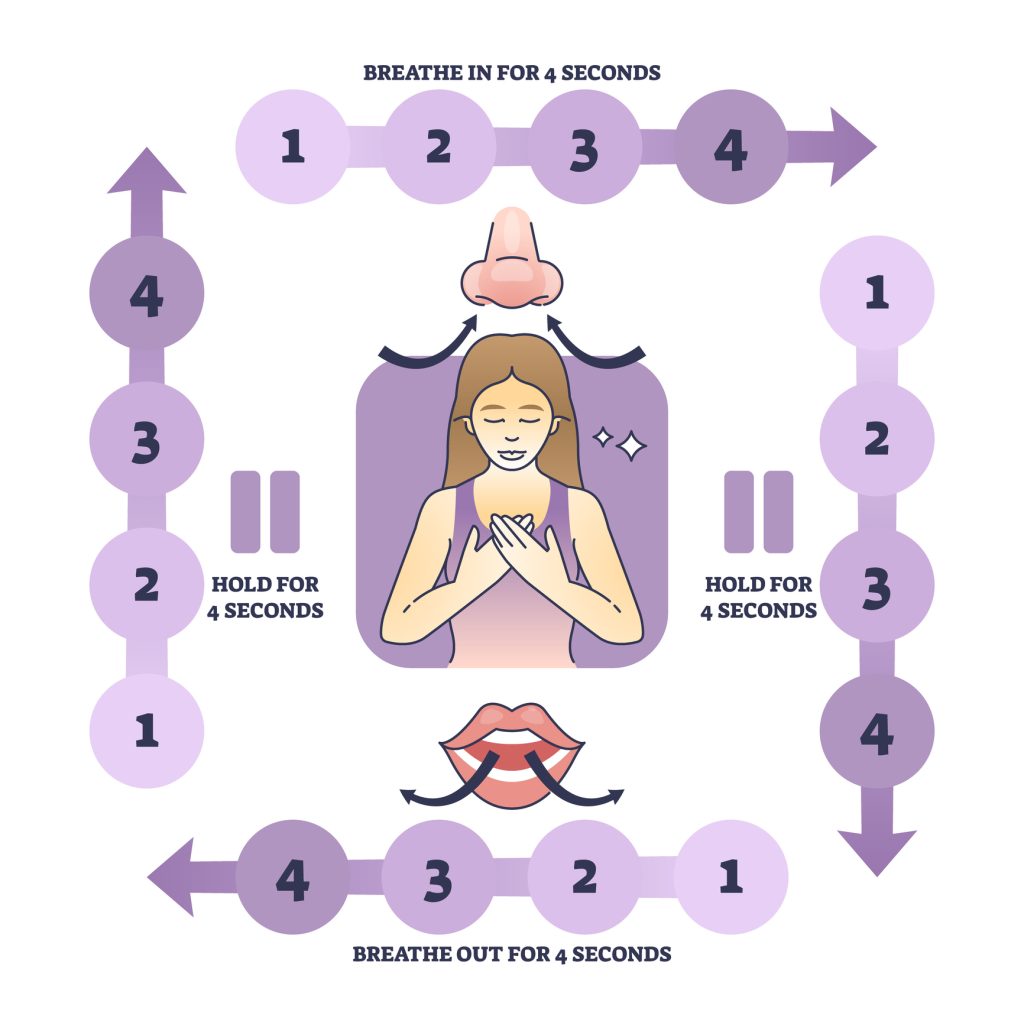
Photo: Duke Health & Well Being
- Duration: 2 - 3 minutes
- Best for: sudden stress, panic, or nerves before a presentation or meeting
Deep, controlled breathing is one of the fastest ways to relieve stress and calm your mind. When you breathe evenly and deeply, your nervous system also begins to slow down. This also helps steady your emotions and bring a sense of calm.
How to do it:
- Step 1: Inhale through your nose for 4 counts
- Step 2: Hold for 4 counts
- Step 3: Exhale through your mouth for 4 counts
- Step 4: Hold empty for 4 counts
Repeat this process 4 - 6 rounds.
Tip: If counting to 4 feels uncomfortable, start with 3 counts instead. Keeping a steady and even rhythm is more important than the exact number.
Grounding with 5-4-3-2-1
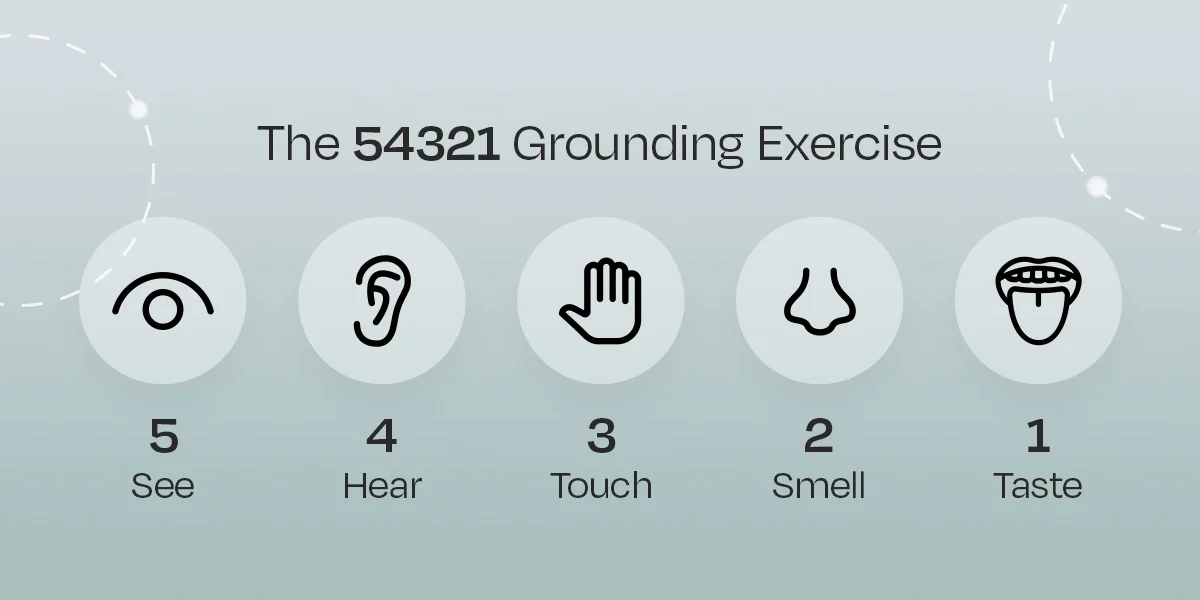
Photo: Stella Center
- Duration: 2 - 3 minutes
- Best for: racing thoughts, panic, overwhelm, or anxiety
The 5-4-3-2-1 grounding technique helps bring your attention back to the present moment by focusing on your five senses. When you direct your focus to each sense, your mind can step out of the stress loop and begin to calm down.
How to do it:
Notice and name the following, either quietly in your mind or out loud:
- 5 things you can SEE: Look around and notice five objects near you.
- 4 things you can FEEL or TOUCH: For example, feet on the floor, clothes on your skin, air on your face, etc.
- 3 things you can HEAR: Listen for nearby sounds like voices, traffic, birds, etc.
- 2 things you can SMELL: For example, the smell of flowers in the room. If nothing is obvious, think of two scents you enjoy.
- 1 thing you can TASTE: Notice any taste in your mouth, or imagine the taste of a food you like.
Don't forget to finish with a deep, slow breath and let your body relax.
Tip:
- Say it out loud: Naming the things you notice can help strengthen your focus.
- Do not judge: Judging makes the mind more reactive. Simply notice and observe what is there, without labeling it as good or bad.
Mindful breathing
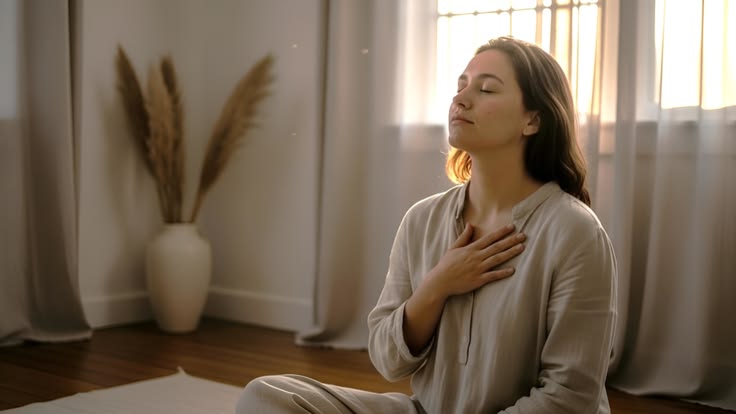
Photo: @Vocal via Pinterest
- Duration: 3 - 10 minutes
- Best for: daily practice, reducing background anxiety
Breathing meditation is one of the most basic forms of meditation. It is the starting point for many mindfulness practices, because it builds the foundation for focus and awareness.
By paying attention to your breath and slowing it down, your heart rate, blood pressure, and stress levels gradually settle, creating a state of relaxation and being present in the moment.
How to do it:
- Step 1: Sit comfortably with your back supported.
- Step 2: Close your eyes or gently lower your gaze toward the floor.
- Step 3: Breathe naturally.
- Step 4: Simply notice the breath - the air moving through your nose, your chest rising, or your belly expanding.
- Step 5: When your mind wanders, gently bring your attention back to your breath. No judging yourself, just return your focus to the breath.
Tip: The goal is not to keep your mind completely still. You're practicing correctly if you recognize your mind wandering and bring it back.
Body scan meditation

Photo: fizkes/Adobe Stock
- Duration: 5 - 20 minutes
- Best for: physical tension, relaxing at the end of the day, or difficulty sleeping
Most of us carry tension in our bodies without realizing it such as stiff shoulders, clenched jaw, or furrowed brows. Body scan is a slow, self-examination process from head to toe, focusing on each part of the body and being aware of every physical sensation. When your focus shifts from thoughts to the body, the mind becomes quieter, and stress naturally begins to ease.
How to do it:
- Step 1: Get comfortable
Sit or lie down in a relaxed position. Close your eyes if you like and take a few natural breaths to let your body settle.
- Step 2: Choose a starting point
Start at either the top of your head or your toes. Choose a direction and move slowly through the body.
- Step 3: Focus on each area of the body
Move your awareness through every part of your body, including: head and forehead, eyes, jaw, neck, shoulders and arms, chest and back, abdomen and hips, thighs and knees, calves and feet (or vice versa if you choose starting from toes).
At each area, simply notice any sensations - tension, warmth, coolness, or even no sensation at all.
- Step 4: Don't try to change anything
Just observe. If you feel tension, simply note "there is tension." Meanwhile, many areas will relax on their own.
- Step 5: If your mind wanders
It is absolutely normal if your mind wanders. When you realize you're thinking, gently bring your attention back to the part of your body you're scanning.
- Step 6: Finish the scanning
After scanning your whole body, take a few breaths and feel your whole body, then open your eyes.
Tip: This technique works best while lying in bed before sleep.
Walking meditation

Photo: Quang Nguyen Vinh via Pexels
- Duration: 10 - 20 minutes
- Best for: people not enjoy sitting meditation, lunch breaks, when processing strong emotions
Meditation does not always mean sitting still in one place. Walking meditation helps both the body and mind to slow down through gentle movements.
During a normal walk, your body moves automatically but your mind may be elsewhere. During walking meditation, you pay attention to the movement of your body and every step you take. When your attention is focused on the present experience, the negative thoughts or stress are gradually controlled.
How to do it:
- Step 1: Choose a quiet path
This could be a park, garden, small hallway, or a short path.
- Step 2: Pause for a few seconds before starting
Stand straight, relax your shoulders, and breathe naturally for 2-3 breaths to calm your body.
- Step 3: Begin walking slowly
Walk a little slower than usual so you can clearly feel the movement of your feet.
- Step 4: Focus on each step
Feel the stages of walking: lifting the foot, bringing the foot forward, foot touching the ground, and body weight shifting to that foot
- Step 5: Notice what's around you
You can also pay attention to the rhythm of your body's movement, the air on your skin, surrounding sounds, and colors.
- Step 6: When your mind wanders
Gently bring your attention back to your steps if your mind wanders.
Walk for 5-10 minutes, or longer if you wish.
Tip:
- Leave your phone in your pocket - no music or podcasts.
- Don't walk too fast, walk slowly and stay aware of each step.
Loving-kindness meditation

Photo: Radiance Yoga
- Duration: 10 - 15 minutes
- Best for: relationship stress, self-criticism, or feelings of loneliness
Loving-kindness meditation focuses on developing kindness and compassion through simple, gentle phrases - first directed towards yourself, then extended to others. This may sound strange, but it works well when stress comes from conflict, comparison, or self-judgment.
Over time, it helps soften self-criticism and negativity, reduce stress responses to conflict, increase feelings of connection with others, and support a positive state of mind.
How to do it:
- Step 1: Sit quietly and close your eyes, and breathe naturally for a few moments
- Step 2: Silently repeat these phrases slowly to yourself:
- "May I be happy."
- "May I be healthy."
- "May I be safe."
- "May I live with ease."
- Step 3: Think about someone you love (your mom, dad, friend, etc) and repeat similar phrases to them.
- Step 4: Think about a neutral person (someone you neither like nor dislike) and repeat similar phrases to them.
- Step 5: Extend those wishes to everyone, everywhere.
Tip:
- If it feels uncomfortable to send kindness to yourself, imagine a younger version of yourself as a child.
- Do not wait for the feeling first, just simply repeat the phrases. The intention is usually followed by the feeling naturally.
Tips to make mindfulness & meditation part of life
To make mindfulness and meditation a natural part of life, the key is not long sessions, but bringing them into everyday moments.
- Let stressful moments remind you
Stress is often the clearest signal that you need a pause. When you feel overwhelmed, distracted, or anxious, stop for a moment and take a few slow breaths. Even a short pause can help reset your mind.
- Add mindfulness to daily activities
Mindfulness can be applied to simple activities in your daily like, such as eating, walking, cleaning, showering, etc. Start with just one activity and give it full attention. Over time, it becomes easier to focus on the present without distractions.
- Practice regularly for short periods
Short and consistent practice is usually more helpful than long but infrequent ones. Even 5 - 10 minutes a day can help build mindfulness into a daily habit.
- Find a comfortable place
You don't need a dedicated meditation room with perfect soundproofing. Any quiet space where you feel relaxed and safe is enough to help you settle your mind.
- Don't pressure yourself to do it right immediately
Even experienced practitioners get distracted at times. Don't worry too much about doing it perfectly. Meditation has no strict timeline or perfect method. Everyone can try to do it slowly at a pace that suits them.
Conclusion
Stress is a normal part of life, but it needs to be managed. Mindfulness and meditation may not remove stress completely, but they can change how you deal with it. With regular practice, you may find yourself responding to stress more calmly and recovering from it more quickly. That's one of the great ways to improve your overall well-being and quality of life.
Choose one technique from this list and try it today!
Más artículos relacionados

Glowing Skin 101: Best Skincare Tips for Every Season
Seasonal skincare tips to keep your skin glowing year-round - adjust your routine, avoid common mistakes, and build healthy habits for radiant skin in every season.
LEER MÁS
A New Chapter of Tranquility: Orient Spa is Moving!
Our Hoan Kiem Lake branch at 18 Bao Khanh Street is relocating to a beautiful cozy new home at 113 Hang Bong Street, just a 7-minute walk away.
LEER MÁS
Anti-Aging Secrets: Natural Ways to Keep Your Skin Youthful
The anti-aging world is vast, from natural products to powerful serums and even high-tech treatments. But there's always something timeless about natural methods.
LEER MÁS